Food Packaging Bags Wholesale | Custom Printed Pouch Supplier
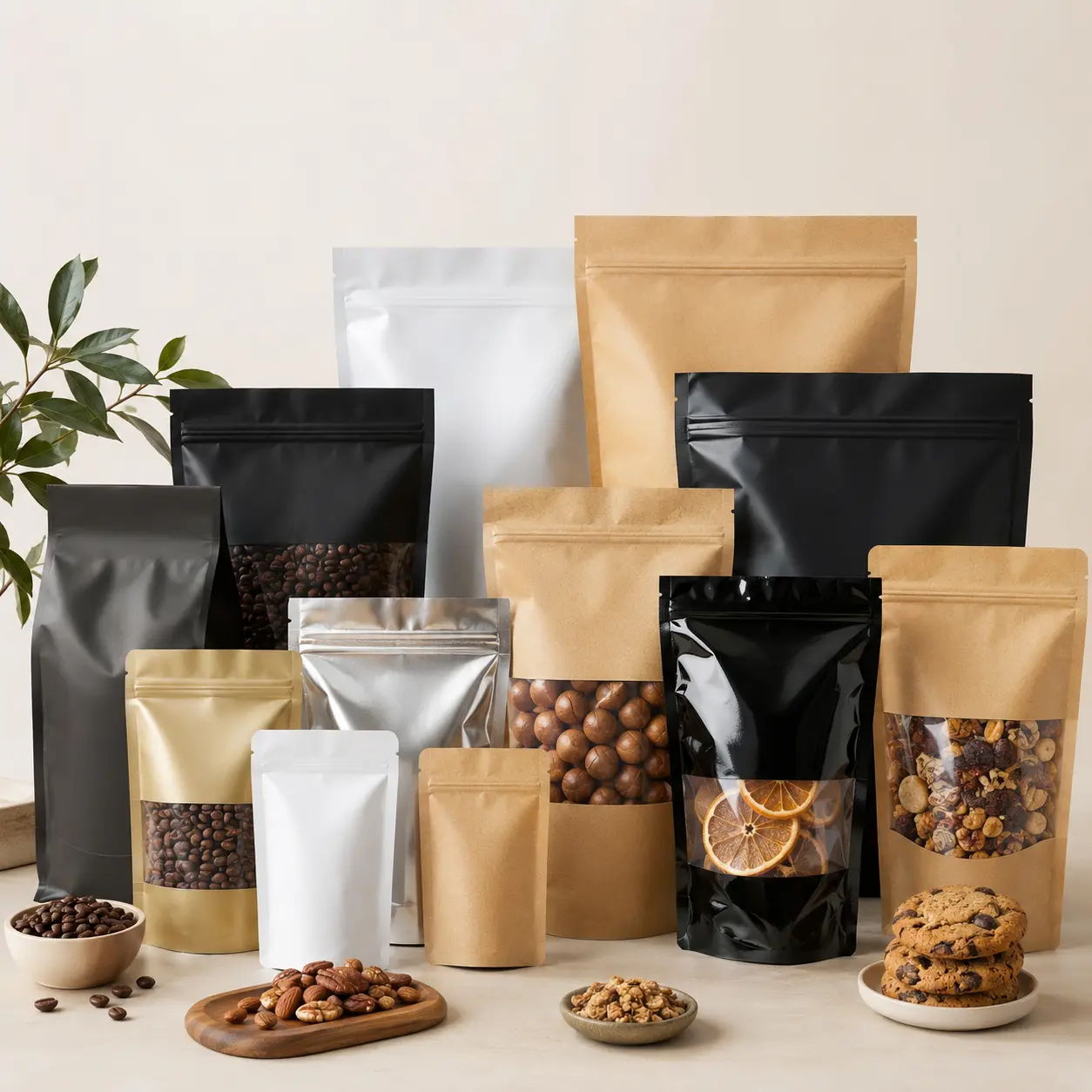
Food packaging must protect freshness, run smoothly on filling equipment, communicate the brand clearly, and remain stable through storage and international shipping. For importers, food brands, and procurement teams, choosing the right food packaging bag starts with the product’s moisture sensitivity, oil content, filling temperature, shelf-life target, package weight, and retail format.
YUTOP supplies customized flexible packaging for food, pet food, household, beauty, and other applications. Its food range includes stand-up pouches, three-side-seal bags, four-side-seal bags, eight-side-seal bags, vacuum bags, roll film, and spout pouches. Buyers can review the company’s food packaging solution before requesting a material and pouch recommendation.
What Are Wholesale Food Packaging Bags?
Wholesale food packaging bags are flexible pouches purchased in bulk for commercial filling, retail distribution, private-label production, or resale. Unlike standard stock bags, custom wholesale pouches can be produced to a specified size, film structure, print design, closure, and packing method.A wholesale order may include printed or unprinted bags, resealable closures, clear or high-barrier structures, custom branding, and dimensions matched to manual or automatic filling equipment.
For B2B sourcing, the selected bag must protect the food, meet market requirements, and perform consistently—not simply offer the lowest unit price.
Why Choose Custom Printed Food Packaging Pouches?
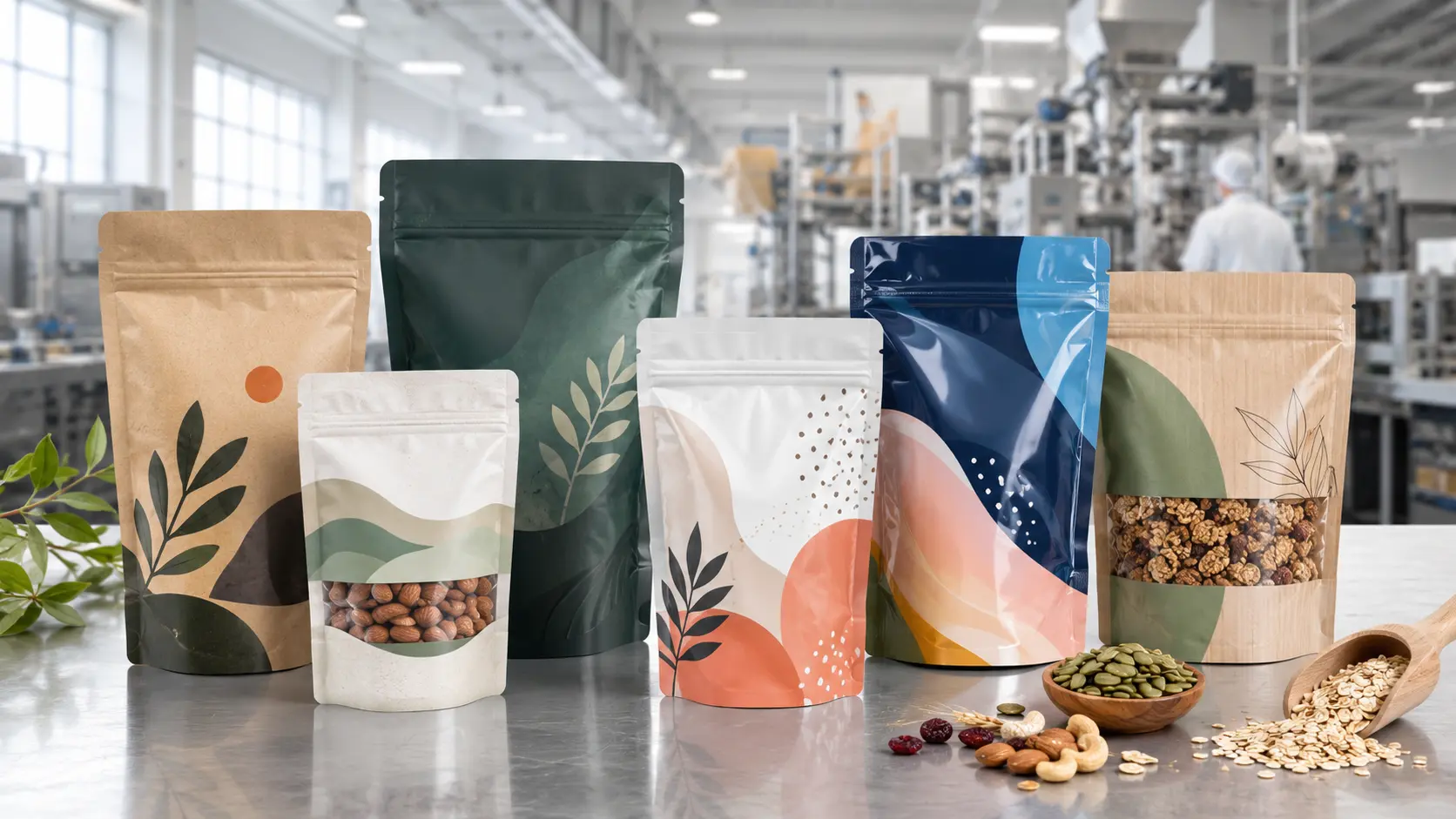
Custom printed food packaging pouches combine product protection with retail communication. They allow food brands to display logos, ingredients, nutritional information, preparation instructions, traceability codes, and market-specific labeling directly on the pouch.A well-planned custom food packaging bag can improve shelf recognition, support multilingual labeling, reduce separate labels, and create consistent branding across package sizes.
Artwork must account for seal areas, zippers, gussets, and cutting tolerances. Buyers should confirm barcode size, text legibility, color references, and regulatory content before production.
What Types of Food Packaging Bags Are Available?
The correct pouch style depends on how the product is filled, displayed, opened, stored, and consumed.Common options include stand-up pouches for shelf display; three- and four-side-seal bags for flat packs; flat-bottom or eight-side-seal bags for coffee, nuts, and pet food; vacuum bags for meat and cheese; spout pouches for pourable products; and printed roll film for form-fill-seal equipment.
YUTOP’s category range includes these formats and related flexible packaging products. Buyers can compare its plastic packaging bag range and flexible packaging roll films.
Which Materials Are Used for Food Packaging Bags?
Food pouches often use two or more film layers because one material rarely provides every required property. The outer layer supports printing and stiffness, the middle layer may add barrier or strength, and the inner layer provides food contact and heat sealing.| Material | Main Function | Common Applications |
| PET | Printability, stiffness, and heat resistance | Snacks, coffee, and spices |
| BOPP | Gloss and moisture resistance | Bakery products, candy, and dry foods |
| PE or LLDPE | Flexible heat-sealing layer | Frozen food, powders, and liquids |
| CPP | Heat-seal performance and heat resistance | Snacks and heat-processed products |
| PA/Nylon | Puncture resistance and flexibility | Meat, seafood, and vacuum packs |
| VMPET | Enhanced light and gas barrier | Coffee, tea, and powders |
| Aluminum foil | Strong light, oxygen, and moisture barrier | Sensitive foods and long-shelf-life products |
YUTOP’s flexible-film guidance lists PE, PET, BOPP, CPP, Nylon, metallized film, and aluminum foil as common choices, with the final structure selected according to product and storage needs.
How Do Barrier Materials Protect Food Freshness and Shelf Life?
Barrier materials slow the movement of oxygen, water vapor, aromas, oils, and light through the package. The required barrier level depends on what causes the food to deteriorate.For example:
• Crispy snacks need moisture resistance.
• Coffee and tea need aroma, oxygen, and often light protection.
• Powders need moisture control and reliable seals.
• Frozen foods need flexibility at low temperatures.
• Meat and seafood need puncture resistance and oxygen control.
• Oily foods need compatible inks, adhesives, and sealant layers.
A higher barrier is not automatically the correct choice. It can increase costs or create unnecessary structural complexity. Buyers should define the target shelf life, storage temperature, filling process, and distribution route before selecting the laminate.
What Printing Methods Are Available for Custom Food Pouches?
Gravure, digital, and flexographic printing are commonly used for custom flexible packaging.Gravure Printing
Gravure printing is suitable for repeat, high-volume orders that need consistent colors and detailed graphics. It requires printing cylinders, so setup costs are higher, but the unit cost becomes more efficient at larger quantities.YUTOP states that its food packaging films can support up to 10-color rotogravure printing.
Digital Printing
Digital printing suits product launches, short runs, multiple SKUs, and market testing because it does not require conventional printing cylinders.Flexographic Printing
Flexographic printing can suit simpler designs and medium- to-high-volume work. Select a method according to artwork, quantity, film, color requirements, and repeat-order plans.YUTOP’s ordering page notes that customers usually provide finalized designs. Minor text adjustments may be supported, but buyers should not assume full artwork creation from scratch.
What Sizes, Shapes, and Features Can Be Customized?
A custom plastic packaging bag can be adjusted around product weight, fill volume, machinery, display method, and consumer use.Custom variables include:
• Width, height, and gusset depth
• Film thickness and laminate structure
• Matte, glossy, clear, or metallized finish
• Standard or irregular shape
• Press-to-close zipper
• Tear notch or laser scoring
• Hang hole or handle
• One-way degassing valve
• Clear product window
• Spout position, diameter, and cap style
• Printed surface finishing
For liquid or semi-liquid products, a custom spout pouch can provide controlled pouring and resealing.
A spout pouch for coffee concentrate, sauces, fruit puree, or edible oil requires careful testing for leakage, drop resistance, seal strength, and cap compatibility.
Which Food Products Can Be Packed in Flexible Packaging Bags?
Flexible pouches can be engineered for dry, frozen, liquid, oily, vacuum-packed, and heat-processed foods.Applications include:
• Coffee beans, ground coffee, and instant coffee
• Tea leaves and tea powder
• Nuts, dried fruit, candy, and snacks
• Rice, grains, flour, spices, and protein powder
• Frozen food and prepared meals
• Meat, cheese, and seafood
• Sauces, condiments, puree, and beverage concentrates
• Pet treats, dry kibble, and nutritional products
A dry food packaging bag usually prioritizes moisture control and seal reliability. A plastic bag for coffee packaging may require a high-barrier laminate and degassing valve. A tea plastic packaging bag may use a metallized or aluminum-foil structure to protect aroma.
For pet products, a dog food packaging bag or cat food packaging bag may need a zipper, strong seals, puncture resistance, and higher load capacity.
YUTOP’s pet food packaging solution includes stand-up bags, eight-side-seal formats, and roll films for different pet-food products.
Stand-Up Pouches vs Flat-Bottom Bags vs Three-Side-Seal Bags
| Feature | Stand-Up Pouch | Flat-Bottom/Eight-Side-Seal Bag | Three-Side-Seal Bag |
| Shelf display | Stands with a bottom gusset | Stable, box-like presentation | Usually lies flat or hangs |
| Typical products | Snacks, powders, and sauces | Coffee, nuts, and pet food | Samples, tea, spices, and portions |
| Resealable option | Common | Common | Optional |
| Printing area | Front, back, and gusset | Multiple broad panels | Front and back |
| Production complexity | Medium | Higher | Lower |
| Filling suitability | Manual or automatic | Manual or automatic | Efficient for high-volume filling |
Consider eight-side-seal bags for a stable retail presentation, or three-side-seal bags for a compact, cost-conscious flat format.
How to Choose the Right Food Packaging Bag for Your Product
Start with technical requirements rather than appearance. Send the supplier the following information:• Food type and main ingredients
• Net weight or fill volume
• Required shelf life
• Filling temperature and sealing method
• Storage and transportation conditions
• Bag style and finished dimensions
• Packaging-machine details
• Artwork and number of SKUs
• Destination country
• Expected order quantity
Buyers in the USA, Canada, Europe, the Middle East, Asia-Pacific, South America, and Africa should confirm the food-contact, labeling, recycling, and environmental rules that apply in the destination market.
YUTOP states that relevant food packaging films can comply with US FDA and EU food-contact requirements. Buyers should request current declarations and test reports for the exact material structure ordered.
What Determines the Price of Wholesale Food Packaging Bags?
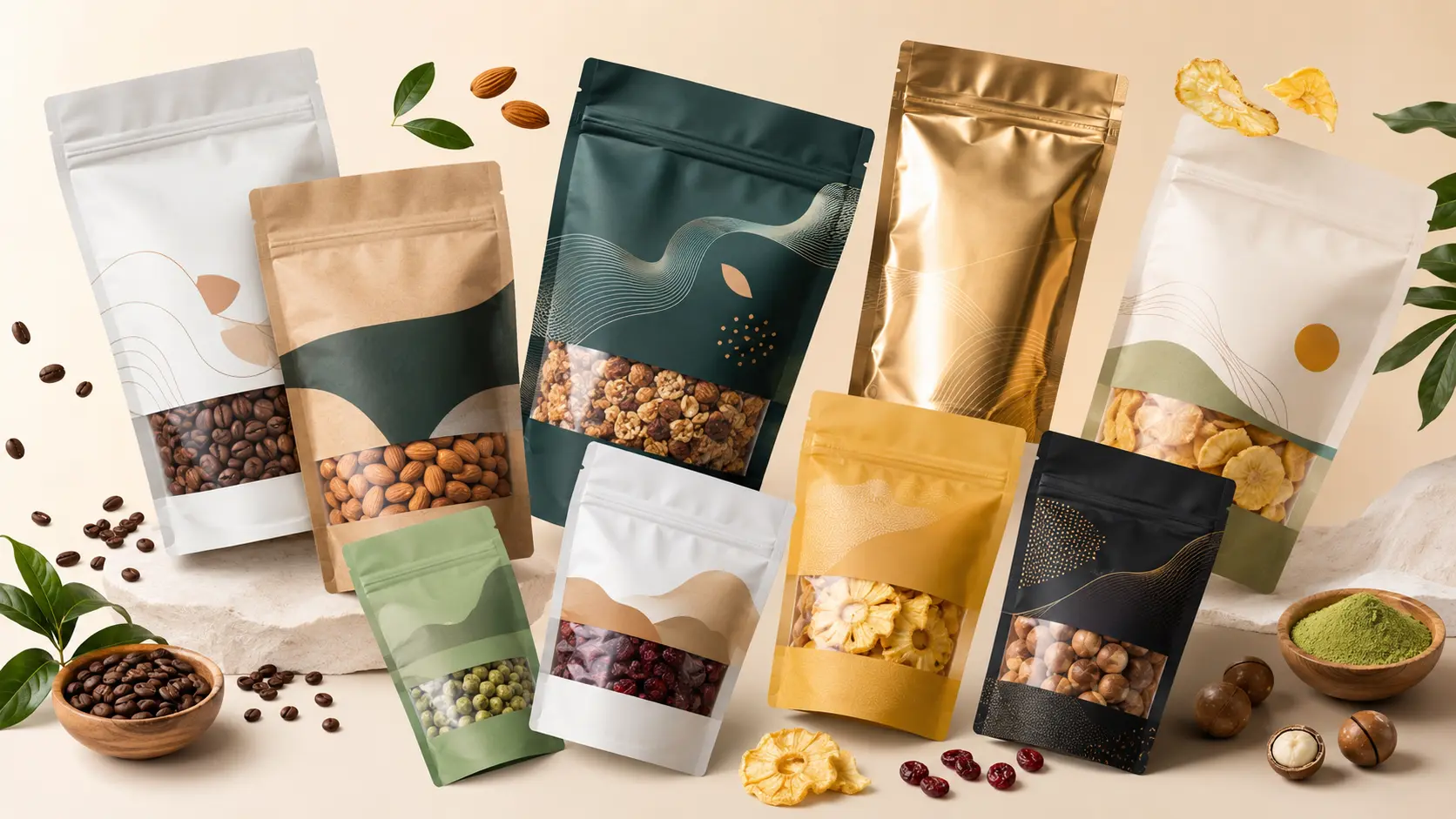
The price of food packaging bags wholesale depends on:• Bag dimensions and film usage
• Material structure and total thickness
• Required oxygen and moisture barrier
• Printing method and number of colors
• Quantity per artwork design
• Zippers, valves, spouts, windows, or special shapes
• Printing cylinders or plate costs
• Testing and documentation
• Export cartons, pallets, and shipping terms
Compare quotations using the same specification. A cheaper quote may use a different thickness, laminate, adhesive, print method, or packing standard.
Ask the supplier to state these details clearly instead of comparing only the unit price.
What Are the MOQ, Sampling, and Production Lead Time?
MOQ depends on pouch style, size, material structure, printing method, and the number of designs. Printed pouches generally require a higher commitment than plain stock packaging, while digital printing may support shorter launch quantities than gravure.A practical sourcing process is:
• Share the product and packaging requirements.
• Confirm the recommended structure and quotation.
• Review a material sample, mock-up, or printed proof.
• Approve dimensions, artwork, colors, and sealing details.
• Start mass production after written approval.
• Complete inspection and export packing.
YUTOP presents a six-stage service process covering requirements, solution planning, sampling, manufacturing, quality inspection and delivery, and after-sales service.
Buyers can review the custom packaging order process and confirm the current MOQ and production schedule for their exact project.
How Is the Quality of Food Packaging Bags Tested?
Quality control should verify both appearance and functional performance.A buyer-focused inspection plan may cover:
• Film thickness and finished dimensions
• Print color and registration
• Surface defects
• Lamination appearance and bond strength
• Heat-seal strength
• Leakage or burst resistance
• Puncture and tear resistance
• Zipper, valve, or spout function
• Food-contact documentation
• Packing quantity and carton condition
For critical products, request pre-production samples and define acceptable tolerances in the purchase specification.
Food-contact documents should match the exact resin, ink, adhesive, and laminate used—not merely a similar packaging product.
How to Choose a Reliable Custom Printed Pouch Supplier
A qualified supplier should explain why a material and pouch style fit the application.Evaluate:
• Experience with similar foods and filling processes
• Knowledge of laminated film structures
• Printing and converting capabilities
• Sample and proof-approval procedures
• Quality records and batch traceability
• Export packing and documentation support
• Communication during production
• Repeat-order consistency
• Corrective-action procedures
Ask for current factory information, relevant test reports, sample bags, and a written specification. Avoid choosing a food packaging bag manufacturer solely from a product photograph or low quotation.
Why Choose YUTOP for Wholesale Food Packaging Bags?
According to its company profile, Shanghai Yutop Plastic Packaging Co., Ltd. has more than 20 years of flexible-packaging experience and operates a production site covering more than 20,000 square meters.Its stated product range includes flexible film, stand-up pouches, vacuum bags, three-side-seal bags, four-side-seal bags, eight-side-seal bags, kraft bags, pasteurization bags, retort bags, and irregular spout packaging.
The company also lists ISO 9001 quality-system certification and SGS testing reports among its quality credentials. Buyers should request current documents relevant to their order and destination market.
International buyers can learn more about YUTOP and discuss materials, sizes, printing, samples, and export requirements with its packaging team.
Frequently Asked Questions
Can YUTOP print our logo and product information?
Yes, custom printing is available. Provide finalized artwork, bag dimensions, color references, barcode requirements, and the number of designs. The suitable printing method can then be selected according to order volume and film structure.Which material is suitable for coffee packaging?
Coffee commonly uses PET/PE, PET/VMPET/PE, or PET/AL/PE structures, depending on shelf life and light-barrier requirements. Whole-bean coffee bags may also require a one-way degassing valve.Can the same bag be used for dog food and cat food?
Possibly, but the dimensions, puncture resistance, zipper, barrier level, and load requirements should match each product. Larger pet-food packages generally require stronger seals and a stable pouch structure.Are custom sizes and low-volume samples available?
Custom sizes are available. Sample type and minimum quantity depend on the material, printing method, pouch format, and whether custom tooling is required. Confirm these details before approving the artwork.What information is required for a quotation?
Send the product type, bag style, dimensions, material preference, thickness, quantity, artwork, special features, destination country, and filling method. A physical sample or reference pouch is also helpful.Does YUTOP support overseas shipping?
YUTOP serves international packaging buyers and can prepare products for export. Confirm Incoterms, cartons, pallets, shipping documents, destination port, and freight responsibility in the final quotation.Conclusion
Choosing the right food packaging bag requires coordination between product protection, pouch design, printing, filling equipment, compliance, and landed cost.A technically suitable bag can help reduce leakage, preserve product quality, improve shelf presentation, and support more consistent packing operations.
YUTOP offers custom printed flexible pouches for dry food, coffee, tea, snacks, frozen food, sauces, dog food, cat food, and other applications.
To receive a suitable proposal, contact YUTOP for a quotation or sample and provide your product details, target bag size, material requirements, artwork, order quantity, and destination market.