< Back
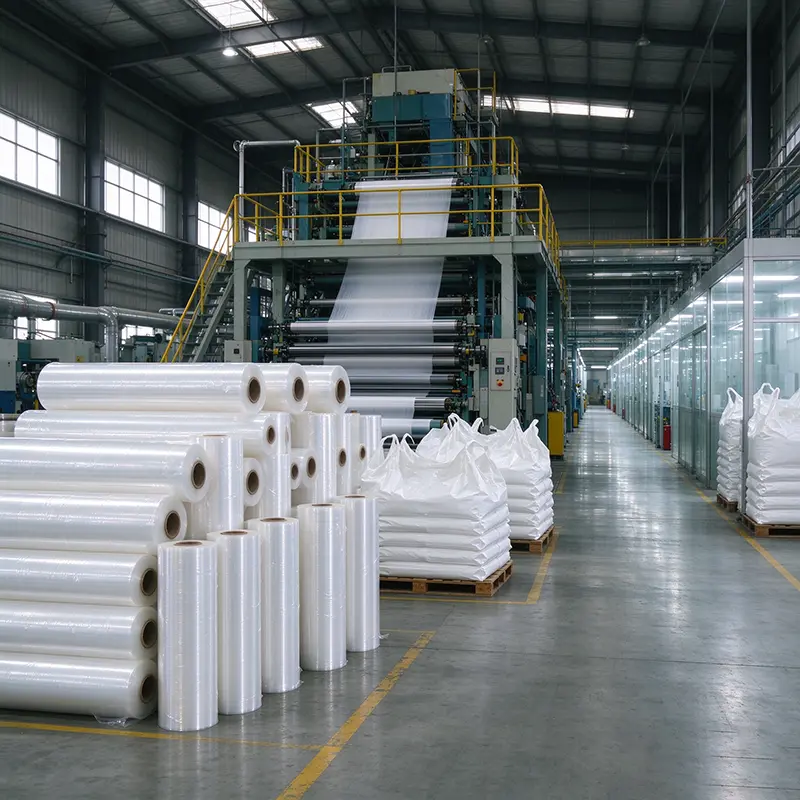
Yutop Packaging is a China-based manufacturer that handles the full cycle of plastic bag production — from raw material selection to printing, sealing, and export-ready packing. This article explains how our manufacturing and packaging process works, what types of plastic bags we produce, and what international buyers should check before placing an order.
Because of this, we approach every inquiry as a custom project rather than a one-size-fits-all order. Our team works with buyers to define:
• Bag style (stand-up pouch, flat pouch, roll film, vest carrier bag, etc.)
• Material structure (single-layer PE, multi-layer laminate, composite film)
• Size, thickness, and load capacity
• Printing method and finish (matte, gloss, spot UV)
• Closure type (zipper, heat seal, spout, tie handle)
This flexibility is why our product categories cover plastic packaging bags, roll film, paper bags, and composite material bags under one roof — buyers sourcing multiple packaging formats can consolidate orders with a single manufacturing and packaging partner instead of managing several vendors.
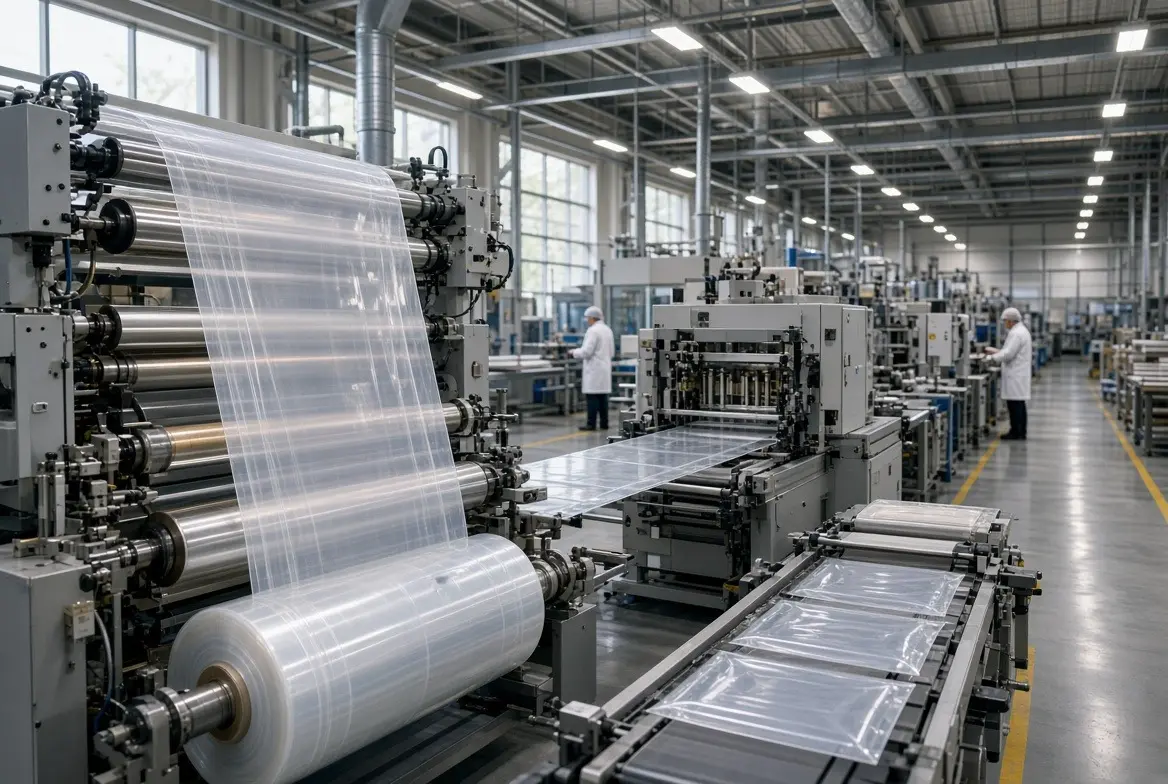
1. Film extrusion or lamination – producing the base plastic film in the required thickness and layer structure.
2. Printing – applying brand artwork, barcodes, and required labeling using flexographic or gravure printing.
3. Bag conversion – cutting and heat-sealing the film into the final bag or pouch shape.
4. Quality inspection – checking seal strength, print accuracy, and dimensional consistency.
5. Export packing – organizing finished bags into cartons or pallets suitable for international shipping.
In short, the company does not just "make bags" — it manages the entire chain between plastic raw material and a packaging product that a buyer's factory or filling line can use immediately on arrival.
Step 1 — Material Preparation — PE, PP, or composite raw materials are selected based on the buyer's required strength, barrier properties, and budget.
Step 2 — Film Extrusion or Lamination — The film is either blown/cast as a single layer or laminated into multiple layers (for example, PET/PE or BOPP/PE) to add barrier protection against moisture, oxygen, or grease.
Step 3 — Printing — Approved artwork is printed onto the film. We confirm colors and layout with the buyer using a digital or physical proof before mass production.
Step 4 — Bag Making — The printed film is cut and sealed into the final format — pouch, roll film, three-side seal bag, eight-side seal bag, or another structure specified in the order.
Step 5 — Inspection and Packing — Finished bags are checked for seal integrity, thickness accuracy, and print quality, then packed into export cartons.
This process is the same core sequence buyers should expect from any serious plastic bag manufacturing and packaging supplier — understanding it helps procurement teams ask better technical questions during supplier evaluation.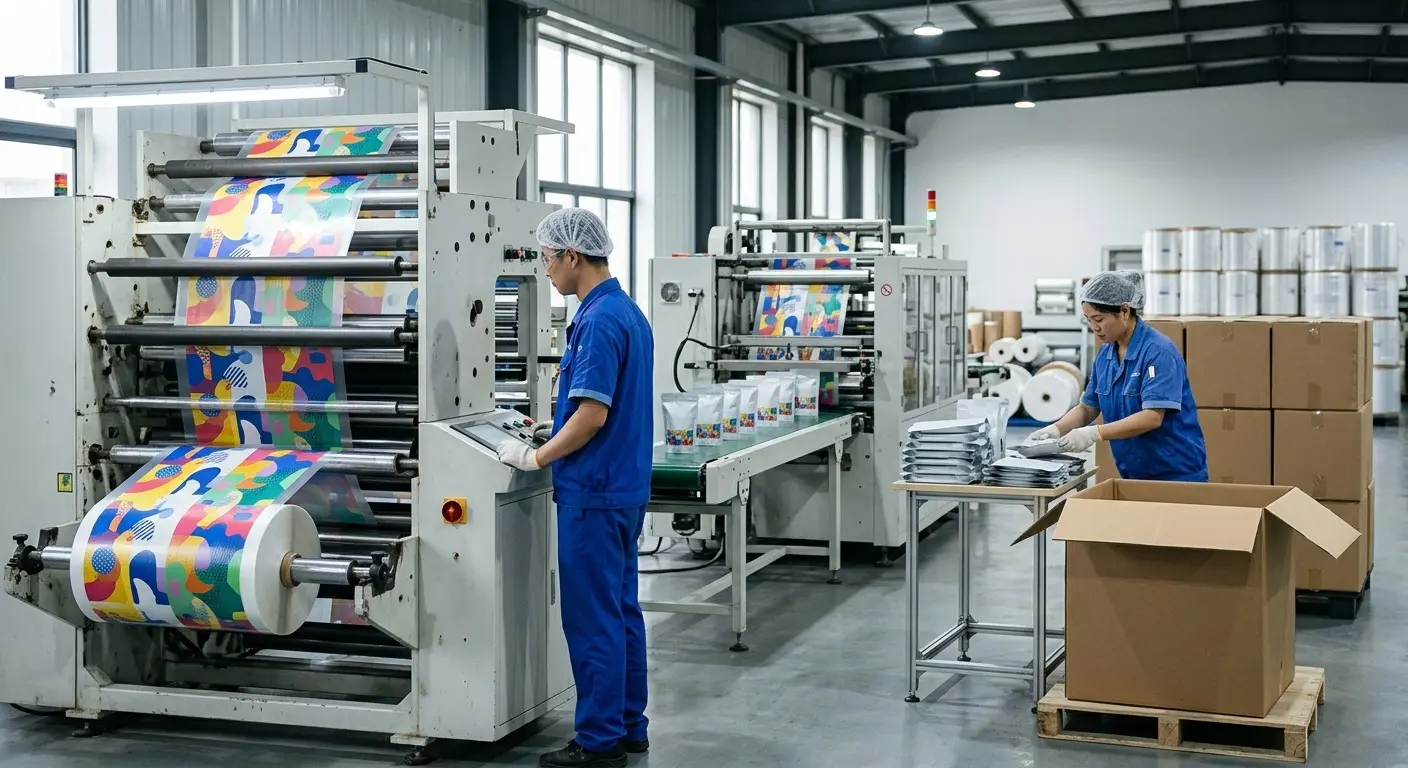
International buyers usually compare suppliers on a few practical points rather than marketing claims. Here is what we bring to that comparison:
• Single-factory production across plastic packaging bags, roll film, paper bags, and composite bags, which simplifies communication for buyers who need more than one packaging format.
• 20+ years of manufacturing background in custom processing, giving our team experience across food, pet food, beauty, and daily necessity packaging.
• Direct factory pricing without middleman markups, since production and export are handled in-house.
• Multi-language support, useful for buyers across Europe, the Middle East, Latin America, and Asia-Pacific who prefer not to communicate only in English.
• Solution-based approach — our Solutions pages are organized by end-use (food, pet food, beauty, daily necessities, garment) so buyers can start from their product rather than guessing which bag style to request.
We do not claim to be the largest or top-ranked supplier in the industry. What we can offer is a transparent manufacturing and packaging process that buyers can verify directly through samples and factory communication.
This table is a starting reference — exact material and structure recommendations depend on the product being packed, shelf-life requirements, and shipping conditions. Buyers can review the full range under Plastic Packaging Bag and Composite Material Packaging Bag.
• Food packaging needs grease resistance, moisture barriers, and food-safe printing inks. See our Food Packaging Solution for daily food, fast food, and food processing formats.
• Pet food packaging requires puncture resistance and often a resealable zipper, since bags are opened and closed repeatedly at home. Details are on our Pet Food Packaging Solution page.
• Beauty product packaging prioritizes print finish and shelf appeal, often using kraft paper bags or laminated pouches — covered under Beauty Products Packaging Solution.
• Daily necessities packaging (household goods, small hardware, textiles) generally needs durable, cost-efficient bags — see Daily Necessities Packaging Solution.
Buyers sourcing for more than one of these categories can request combined quotations, since shared production lines and materials often reduce per-unit cost.
• Brand logo and artwork printing
• Custom bag dimensions and thickness
• Material structure adjusted for the product (barrier level, transparency, matte/gloss finish)
• Compliance-related labeling space (nutrition panels, barcodes, recycling symbols) laid out per the buyer's regulatory requirements
For buyers who are new to sourcing packaging from China, we recommend starting with a technical drawing or an existing bag sample. This shortens the quotation and sampling stage significantly compared to describing requirements in text alone.
We recommend that buyers evaluating any manufacturer — including us — ask for:
• Recent product photos or a video walkthrough of the production line
• A sample of a previously produced bag in a similar structure to what they need
• Lead time for both sampling and mass production, confirmed in writing
This lets procurement teams verify capability directly rather than relying on general claims.
• Seal strength testing to confirm bags will not open during transport or storage
• Print color matching against the approved proof
• Thickness and dimension checks to ensure the bag meets the agreed specification
• Random sampling from finished cartons before export packing is completed
For buyers with strict compliance needs (retail chains, food safety audits, or government tenders), we encourage sharing the required standard in advance so it can be confirmed as part of the production plan, rather than assumed after the order is placed.
• Confirming a written production timeline before deposit payment
• Sharing in-process photos or videos during bulk production on request
• Using consistent raw material batches to avoid color or thickness variation between orders
• Coordinating directly with freight forwarders familiar with flexible packaging shipments (lightweight, high-volume cargo)
Buyers shipping to North America, Europe, the Middle East, or Asia-Pacific should confirm incoterms (FOB, CIF, EXW) early, since freight cost per cubic meter can meaningfully affect the landed cost of lightweight plastic packaging.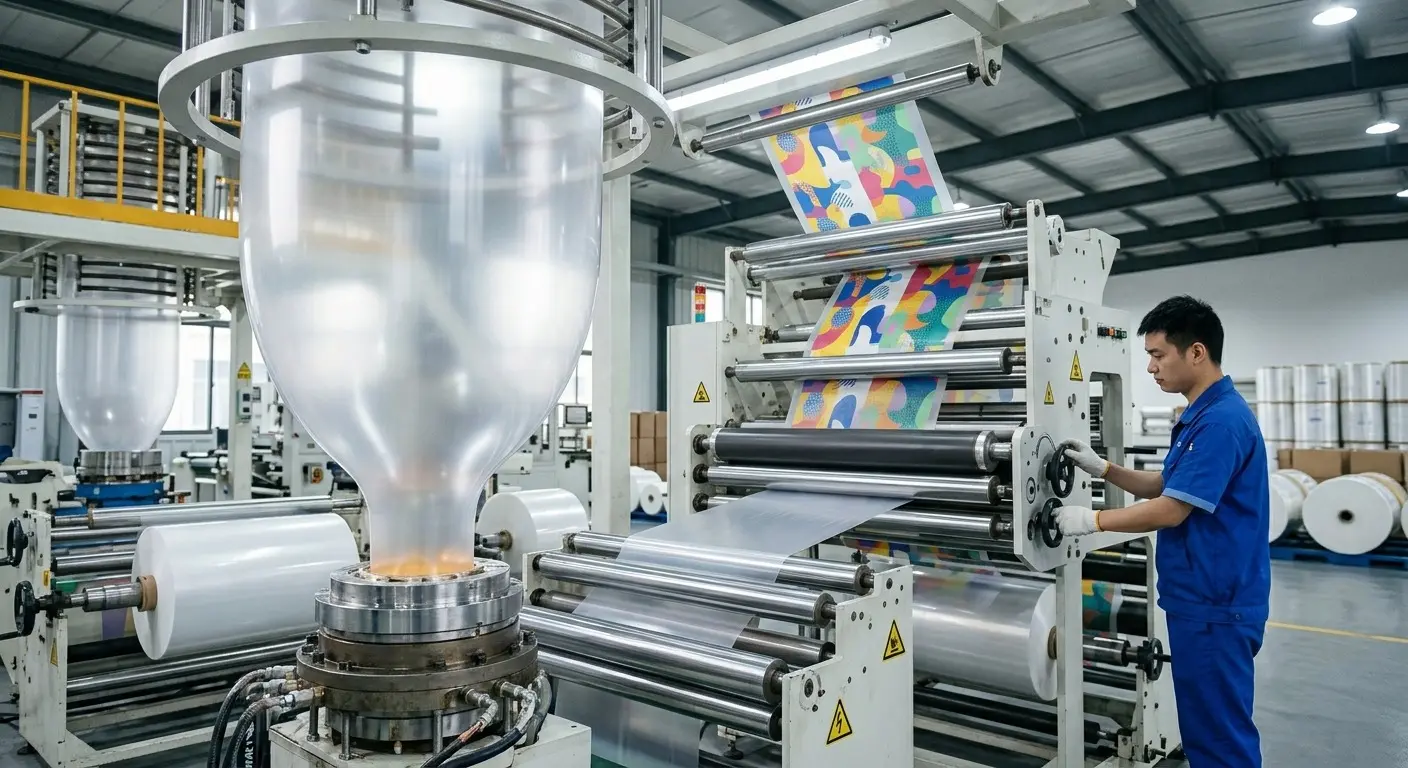
Sustainability requirements vary significantly by market — some buyers need recyclable mono-material structures, others need biodegradable options for specific retail regulations. Depending on the product and target market, options we can discuss include:
• Recyclable mono-material PE structures (replacing multi-material laminates where barrier requirements allow)
• Reduced material thickness where mechanical strength permits
• Paper-based alternatives, such as kraft paper bags, for products that don't require a high moisture barrier
We recommend buyers confirm the specific recycling or biodegradability standard required in their destination market (such as EU packaging regulations or state-level rules in the US), since "eco-friendly" requirements differ by country and are not interchangeable.
• PE (Polyethylene) – flexible, moisture-resistant, widely used for general packaging bags
• PP (Polypropylene) – higher clarity and stiffness, often used for food and retail bags
• PET – used in laminated structures for strength and printability
• BOPP – common outer layer for high-gloss printed pouches
• Kraft Paper (with or without PE lining) – used for beauty and daily necessity packaging
• Composite/laminated films – combining two or more materials for barrier protection, such as pasteurization-resistant or steam-heating-resistant bags
Material selection directly affects both product protection and unit cost, so we typically recommend confirming the product's shelf-life and shipping conditions before finalizing the structure.
1. Product to be packed (and its weight/volume)
2. Preferred bag style and approximate dimensions
3. Required material properties (barrier level, transparency, food-grade requirement)
4. Artwork file or reference sample, if available
5. Order quantity and target destination
Our How to Order/OEM page outlines the standard steps from inquiry to shipment, including sampling and approval stages.
MOQ depends on the bag structure, printing method, and material used. It's best to share your target quantity when requesting a quote so we can confirm feasibility for your specific bag type.
2. Can you produce small plastic packaging bags and large plastic packaging bags in the same order?
Yes, mixed-size orders are possible, though pricing and lead time are calculated per size and structure since each requires separate tooling or film settings.
3. Do you provide plastic packaging bags on a roll as well as pre-made bags?
Yes. We produce both finished bags and roll film formats — roll film is common for buyers with their own automatic filling and sealing equipment.
4. How is the price of packaging plastic bags calculated?
Pricing is based on material type, bag size, thickness, printing complexity, and order quantity. Because these variables change per project, we provide a formal quotation after reviewing your specification rather than a fixed price list.
5. Can you manufacture recyclable plastic packaging?
We can discuss recyclable mono-material options depending on the barrier and strength requirements of your product. Let us know your target market's packaging regulations so we can recommend a suitable structure.
6. Do you support OEM packaging for pet food, rice, and food products?
Yes. Custom printing, sizing, and material structure are available for pet food, rice, and general food packaging. Please refer to our relevant Solutions page or contact us directly with your product details.
If you're currently comparing plastic bag packaging suppliers, we're glad to provide product details, a formal quotation, customization options, or a sample for evaluation. Contact Yutop Packaging with your product requirements, and our team will guide you through the next steps.
Plastic Bag Manufacturing & Packaging Company | Yutop Packaging
Introduction
Finding a dependable partner for the manufacturing and packaging of a plastic bag is one of the more time-consuming steps for any importer, brand owner, or procurement manager. The right supplier needs to combine consistent material quality, accurate production timelines, and packaging that protects the product all the way from the factory floor to the retail shelf.Yutop Packaging is a China-based manufacturer that handles the full cycle of plastic bag production — from raw material selection to printing, sealing, and export-ready packing. This article explains how our manufacturing and packaging process works, what types of plastic bags we produce, and what international buyers should check before placing an order.
Custom Plastic Bag Manufacturing and Packaging Solutions for Every Industry
No two industries package their products the same way. A pet food brand needs a bag that resists punctures during shipping. A skincare brand wants a pouch that looks premium on a shelf. A rice exporter needs a bag strong enough to survive stacking and long-distance transport.Because of this, we approach every inquiry as a custom project rather than a one-size-fits-all order. Our team works with buyers to define:
• Bag style (stand-up pouch, flat pouch, roll film, vest carrier bag, etc.)
• Material structure (single-layer PE, multi-layer laminate, composite film)
• Size, thickness, and load capacity
• Printing method and finish (matte, gloss, spot UV)
• Closure type (zipper, heat seal, spout, tie handle)
This flexibility is why our product categories cover plastic packaging bags, roll film, paper bags, and composite material bags under one roof — buyers sourcing multiple packaging formats can consolidate orders with a single manufacturing and packaging partner instead of managing several vendors.
What Does a Plastic Bag Manufacturing and Packaging Company Do?
A plastic bag manufacturing and packaging company is responsible for converting raw plastic resin into finished, ready-to-use packaging. This typically includes:1. Film extrusion or lamination – producing the base plastic film in the required thickness and layer structure.
2. Printing – applying brand artwork, barcodes, and required labeling using flexographic or gravure printing.
3. Bag conversion – cutting and heat-sealing the film into the final bag or pouch shape.
4. Quality inspection – checking seal strength, print accuracy, and dimensional consistency.
5. Export packing – organizing finished bags into cartons or pallets suitable for international shipping.
In short, the company does not just "make bags" — it manages the entire chain between plastic raw material and a packaging product that a buyer's factory or filling line can use immediately on arrival.
From Raw Material to Finished Bag: Our Manufacturing & Packaging Process
Buyers often ask how a plastic bag actually goes from resin pellets to a finished, printed pouch on their shelf. Here is the general workflow we follow:Step 1 — Material Preparation — PE, PP, or composite raw materials are selected based on the buyer's required strength, barrier properties, and budget.
Step 2 — Film Extrusion or Lamination — The film is either blown/cast as a single layer or laminated into multiple layers (for example, PET/PE or BOPP/PE) to add barrier protection against moisture, oxygen, or grease.
Step 3 — Printing — Approved artwork is printed onto the film. We confirm colors and layout with the buyer using a digital or physical proof before mass production.
Step 4 — Bag Making — The printed film is cut and sealed into the final format — pouch, roll film, three-side seal bag, eight-side seal bag, or another structure specified in the order.
Step 5 — Inspection and Packing — Finished bags are checked for seal integrity, thickness accuracy, and print quality, then packed into export cartons.
This process is the same core sequence buyers should expect from any serious plastic bag manufacturing and packaging supplier — understanding it helps procurement teams ask better technical questions during supplier evaluation.
Why Choose Yutop as Your Plastic Bag Manufacturing & Packaging Partner
International buyers usually compare suppliers on a few practical points rather than marketing claims. Here is what we bring to that comparison:
• Single-factory production across plastic packaging bags, roll film, paper bags, and composite bags, which simplifies communication for buyers who need more than one packaging format.
• 20+ years of manufacturing background in custom processing, giving our team experience across food, pet food, beauty, and daily necessity packaging.
• Direct factory pricing without middleman markups, since production and export are handled in-house.
• Multi-language support, useful for buyers across Europe, the Middle East, Latin America, and Asia-Pacific who prefer not to communicate only in English.
• Solution-based approach — our Solutions pages are organized by end-use (food, pet food, beauty, daily necessities, garment) so buyers can start from their product rather than guessing which bag style to request.
We do not claim to be the largest or top-ranked supplier in the industry. What we can offer is a transparent manufacturing and packaging process that buyers can verify directly through samples and factory communication.
Types of Plastic Bags We Manufacture and Package
Buyers researching plastic packaging bag manufacturers often need to compare formats before deciding what fits their product. Below is a general overview of the bag types we produce.| Bag Type | Common Use | Typical Material | Closure Option |
| Self-Seal Bag | Small retail items, hardware, snacks | PE / OPP | Self-adhesive strip |
| Stand-Up Pouch | Pet food, rice, snacks, powders | PET/PE, laminate | Zipper or heat seal |
| Vacuum Bag | Meat, seafood, frozen food | Nylon/PE | Heat seal |
| Vest Carrier Bag | Retail shopping, supermarkets | HDPE / LDPE | Open top |
| Rice Brick Bag | Rice, grains, bulk food | Laminated composite | Heat seal |
| Three/Four Side Seal Bag | Snacks, tea, small hardware | PET/PE, BOPP/PE | Heat seal |
| Kraft Paper Bag | Beauty, gifting, daily necessities | Paper + PE lining | Fold or handle |
| Eight-Side Seal Bag | Premium food, coffee | Multi-layer laminate | Heat seal, flat base |
| Spout Pouch | Liquids, sauces, baby food | Laminated composite | Screw-cap spout |
Plastic Bag Manufacturing for Food, Pet Food, Beauty & Daily Products
Different product categories come with different packaging priorities:• Food packaging needs grease resistance, moisture barriers, and food-safe printing inks. See our Food Packaging Solution for daily food, fast food, and food processing formats.
• Pet food packaging requires puncture resistance and often a resealable zipper, since bags are opened and closed repeatedly at home. Details are on our Pet Food Packaging Solution page.
• Beauty product packaging prioritizes print finish and shelf appeal, often using kraft paper bags or laminated pouches — covered under Beauty Products Packaging Solution.
• Daily necessities packaging (household goods, small hardware, textiles) generally needs durable, cost-efficient bags — see Daily Necessities Packaging Solution.
Buyers sourcing for more than one of these categories can request combined quotations, since shared production lines and materials often reduce per-unit cost.
OEM & Custom Plastic Bag Packaging Manufacturing Services
Most of our international orders are OEM or private-label projects rather than stock designs. A typical custom project includes:• Brand logo and artwork printing
• Custom bag dimensions and thickness
• Material structure adjusted for the product (barrier level, transparency, matte/gloss finish)
• Compliance-related labeling space (nutrition panels, barcodes, recycling symbols) laid out per the buyer's regulatory requirements
For buyers who are new to sourcing packaging from China, we recommend starting with a technical drawing or an existing bag sample. This shortens the quotation and sampling stage significantly compared to describing requirements in text alone.
Our Plastic Bag Manufacturing Facility and Production Capacity
Yutop operates as a direct manufacturer rather than a trading company, which means quotations, sample development, and production scheduling are handled internally without third-party coordination delays. Our background is in custom processing, built over more than two decades of factory operation.We recommend that buyers evaluating any manufacturer — including us — ask for:
• Recent product photos or a video walkthrough of the production line
• A sample of a previously produced bag in a similar structure to what they need
• Lead time for both sampling and mass production, confirmed in writing
This lets procurement teams verify capability directly rather than relying on general claims.
Quality Control in Plastic Bag Manufacturing and Packaging
Packaging failures are expensive — a weak seal or inaccurate print run can affect an entire shipment. Our quality checks generally focus on:• Seal strength testing to confirm bags will not open during transport or storage
• Print color matching against the approved proof
• Thickness and dimension checks to ensure the bag meets the agreed specification
• Random sampling from finished cartons before export packing is completed
For buyers with strict compliance needs (retail chains, food safety audits, or government tenders), we encourage sharing the required standard in advance so it can be confirmed as part of the production plan, rather than assumed after the order is placed.
How We Ensure Fast, Reliable Plastic Bag Manufacturing and Packaging
Buyers care about two things beyond price: will the order arrive on time, and will it match the approved sample. We manage this through:• Confirming a written production timeline before deposit payment
• Sharing in-process photos or videos during bulk production on request
• Using consistent raw material batches to avoid color or thickness variation between orders
• Coordinating directly with freight forwarders familiar with flexible packaging shipments (lightweight, high-volume cargo)
Buyers shipping to North America, Europe, the Middle East, or Asia-Pacific should confirm incoterms (FOB, CIF, EXW) early, since freight cost per cubic meter can meaningfully affect the landed cost of lightweight plastic packaging.
Sustainable and Eco-Friendly Plastic Bag Manufacturing Options
Sustainability requirements vary significantly by market — some buyers need recyclable mono-material structures, others need biodegradable options for specific retail regulations. Depending on the product and target market, options we can discuss include:
• Recyclable mono-material PE structures (replacing multi-material laminates where barrier requirements allow)
• Reduced material thickness where mechanical strength permits
• Paper-based alternatives, such as kraft paper bags, for products that don't require a high moisture barrier
We recommend buyers confirm the specific recycling or biodegradability standard required in their destination market (such as EU packaging regulations or state-level rules in the US), since "eco-friendly" requirements differ by country and are not interchangeable.
Plastic Bag Manufacturing and Packaging: Materials We Use
Common materials used across our production include:• PE (Polyethylene) – flexible, moisture-resistant, widely used for general packaging bags
• PP (Polypropylene) – higher clarity and stiffness, often used for food and retail bags
• PET – used in laminated structures for strength and printability
• BOPP – common outer layer for high-gloss printed pouches
• Kraft Paper (with or without PE lining) – used for beauty and daily necessity packaging
• Composite/laminated films – combining two or more materials for barrier protection, such as pasteurization-resistant or steam-heating-resistant bags
Material selection directly affects both product protection and unit cost, so we typically recommend confirming the product's shelf-life and shipping conditions before finalizing the structure.
How to Order Custom Manufactured and Packaged Plastic Bags
For buyers preparing to request a quotation, having the following ready speeds up the process significantly:1. Product to be packed (and its weight/volume)
2. Preferred bag style and approximate dimensions
3. Required material properties (barrier level, transparency, food-grade requirement)
4. Artwork file or reference sample, if available
5. Order quantity and target destination
Our How to Order/OEM page outlines the standard steps from inquiry to shipment, including sampling and approval stages.
Plastic Bag Manufacturing and Packaging FAQs
1. What is the minimum order quantity (MOQ) for custom plastic bags?MOQ depends on the bag structure, printing method, and material used. It's best to share your target quantity when requesting a quote so we can confirm feasibility for your specific bag type.
2. Can you produce small plastic packaging bags and large plastic packaging bags in the same order?
Yes, mixed-size orders are possible, though pricing and lead time are calculated per size and structure since each requires separate tooling or film settings.
3. Do you provide plastic packaging bags on a roll as well as pre-made bags?
Yes. We produce both finished bags and roll film formats — roll film is common for buyers with their own automatic filling and sealing equipment.
4. How is the price of packaging plastic bags calculated?
Pricing is based on material type, bag size, thickness, printing complexity, and order quantity. Because these variables change per project, we provide a formal quotation after reviewing your specification rather than a fixed price list.
5. Can you manufacture recyclable plastic packaging?
We can discuss recyclable mono-material options depending on the barrier and strength requirements of your product. Let us know your target market's packaging regulations so we can recommend a suitable structure.
6. Do you support OEM packaging for pet food, rice, and food products?
Yes. Custom printing, sizing, and material structure are available for pet food, rice, and general food packaging. Please refer to our relevant Solutions page or contact us directly with your product details.
Conclusion
Choosing a plastic bag manufacturing and packaging company is a decision that affects product protection, shelf presentation, and shipping cost all at once. Whether you need individual plastic bags for retail, plastic packaging bags on a roll for automated filling lines, or a fully custom OEM pouch for a food or beauty brand, the process starts with a clear specification and a supplier willing to walk through material and production details with you directly.If you're currently comparing plastic bag packaging suppliers, we're glad to provide product details, a formal quotation, customization options, or a sample for evaluation. Contact Yutop Packaging with your product requirements, and our team will guide you through the next steps.